 GBP Autopilot
The honest answer: there is no magic number. Google has not published a specific review count threshold that unlocks better rankings. But that does not mean review volume is arbitrary — it matters, it is measurable, and there are practical benchmarks you can work toward based on your market and vertical.
Here is what the data actually says about how many Google reviews your local business needs, and how to think about the right target for your situation.
What the Research Says
Consumer trust thresholds
BrightLocal's Local Consumer Review Survey found that 59% of consumers expect a business to have between 20 and 99 reviews before they consider it credible.[^1] A business with fewer than 10 reviews is not necessarily seen as untrustworthy — but it lacks the volume that signals an established, active business.
The same survey found 71% of consumers would not use a business rated below 3.0 stars.[^1] Rating matters more than raw count at the extremes: a 4.9 average with 8 reviews is more credible than a 3.2 average with 200 reviews, for most customers.
Ranking signal
Google's own guidance confirms that "more reviews and positive ratings can help your business's local ranking" under the Prominence factor.[^2] Review signals — quantity, recency, rating, diversity of reviewer profiles — collectively influence where you appear in the local pack and on Google Maps.
Research from local SEO analysts consistently places review signals among the top factors for Google Maps rankings, alongside proximity and profile completeness.
Practical Benchmarks by Market and Vertical
There is no universal "enough." The right target depends on what your top competitors have and what your market size supports.
How to find your real benchmark
- Search Google Maps for your primary service + city (e.g., "emergency plumber Chicago" or "family dentist Austin")
- Look at the top 3 businesses in the local pack
- Note their review counts and average ratings
- Your floor target is to match the lowest of those three; your goal is to match or exceed the median
This is the only benchmark that actually matters for ranking purposes — not a general industry average, but the specific competitive set in your specific market.
General industry reference ranges
These are rough observations from common US local service markets. Your local competitive set may vary significantly.
| Vertical | Typical floor to be competitive | Target to lead local pack |
|---|---|---|
| Plumbing / HVAC | 40–80 reviews | 100–200+ |
| Dental | 50–100 reviews | 150–300+ |
| Chiropractic | 30–60 reviews | 75–150+ |
| Auto repair | 50–100 reviews | 150–350+ |
| Restaurant | 80–200 reviews | 300–1,000+ |
| Law firm | 15–40 reviews | 50–150+ |
| Medspa | 30–70 reviews | 100–250+ |
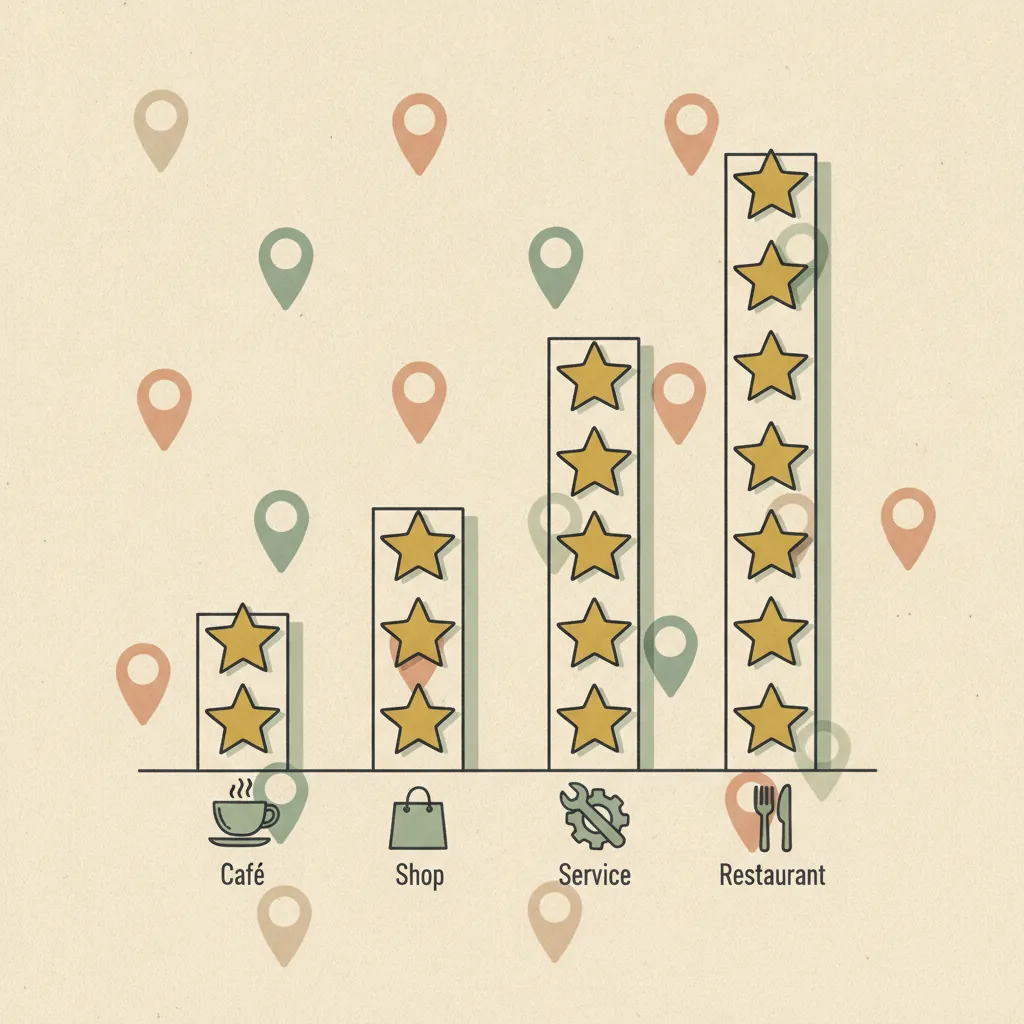
Restaurants tend to have the highest review counts because the transaction frequency is higher — a customer visits a restaurant weekly; they visit a plumber once a year. Volume naturally follows transaction frequency, so set expectations accordingly.
Why Recency Often Matters as Much as Count
A business with 300 reviews from 2019–2021 and nothing in the past year looks stale. A business with 60 reviews, a third of which were posted in the last 90 days, signals an active, current operation to both Google and prospective customers.
BrightLocal found that consumers specifically look for recent reviews — older reviews carry less weight in purchase decisions.[^1] Google's algorithm also factors recency into prominence signals.
The practical implication: do not obsess over total review count at the expense of consistency. A business that gets 5–10 new reviews per month for a year will outperform one that ran a review campaign, got 50 reviews in a week, and then stopped asking.
The Rating Floor: 4.0 Stars Minimum
Review count goals are secondary to maintaining a competitive average rating. The general consensus from local SEO practitioners and consumer behavior data is that:
- Below 3.0: majority of consumers will not consider using you
- 3.0–3.9: significant portion of consumers will pass, particularly for trust-sensitive services (healthcare, legal)
- 4.0–4.4: competitive for most markets
- 4.5–4.9: strong signal; within this range, count becomes the differentiator
Do not sacrifice rating to chase volume. A campaign that results in a wave of low-effort reviews that pull your average down from 4.8 to 4.4 was counterproductive. Quality matters alongside quantity.
What Actually Moves Your Reviews Count: A Prioritized Action Plan
You cannot shortcut the volume, but you can build it efficiently.
Step 1: Ask everyone, every time
The single biggest gap at most local service businesses is not a tool problem — it is an asking problem. If you are doing 30 jobs or appointments per week and asking none of them for a review, you are leaving the full pipeline untapped. Ask every customer, through the same process, regardless of how you think the interaction went.
Step 2: Make it frictionless
The review link (the URL that sends customers directly to your Google review form) should be on your receipt, in your invoice email, on your technician's business card, in your confirmation texts. Every extra step between a customer's decision to leave a review and actually leaving one loses some percentage of people.
Step 3: Follow up once
Most reviews are left within 24–48 hours of the ask. A single follow-up to customers who have not responded, sent 3–5 days after the first ask via a different channel (SMS first, then email), recovers a meaningful percentage.
Step 4: Never stop asking
Reviews are not a campaign — they are a pipeline. The businesses with 400 reviews are not businesses that ran a big push one time. They are businesses that asked every customer for two or three years.
What Not to Do to Boost Review Count
A few tactics that seem like shortcuts but create serious risk:
Buying reviews: Google removed over 170 million policy-violating reviews in 2023.[^1] Purchased reviews are increasingly detectable. A single enforcement action can remove your entire review portfolio overnight.
Incentivizing reviews: Offering discounts, free services, or any reward in exchange for a review is prohibited by Google policy and, since 2024, enforceable by the FTC with fines up to $51,744 per violation.
Review gating: Routing only happy customers to Google while directing unhappy ones elsewhere is review gating — explicitly prohibited by Google and the FTC.
Review stations: Having a tablet in your lobby for customers to leave reviews in sequence violates Google's policy and risks a cluster of reviews from the same IP address, which triggers automated filters.
How to Track Whether Your Reviews Are Working
Review count and rating are the outputs. But the business metric that reviews actually move is new customer inquiries. Track:
- Monthly volume of calls / forms / direction requests from Google Maps (available in GBP Insights)
- Position in local pack for your 2–3 most important service + city searches (check in an incognito window or use a rank tracking tool)
- Percentage of new customers who mention finding you on Google
If your reviews are growing but your calls from Google are flat, the constraint may be elsewhere — profile completeness, category selection, or the competitive gap in your specific geography.
For the broader strategy on local SEO factors beyond reviews, see local SEO checklist. For why reviews specifically matter for search visibility, see why Google reviews matter for local SEO.
The Bottom Line
There is no universal answer to "how many Google reviews do you need?" The real answer is: enough to be competitive with the top three businesses in your local pack for your core search term, with a rating above 4.0, and a consistent flow of new reviews over time.
If you are under 30 reviews and your top competitor has 150, that is the gap to close. If you are at 80 reviews and your competitors average 60, you are in a strong position — and the goal is to maintain the rate, not coast.
The path there is always the same: ask every customer, make it easy, and never stop.
For the full system on how to do that consistently, read how to get more Google reviews.
GBP Autopilot automates the review request process — TCPA-compliant SMS, timed follow-ups, and a dashboard that tracks your review velocity over time — at $29–49/mo with no annual contract.
Sources
[^1]: Local Consumer Review Survey 2024 — BrightLocal [^2]: Tips to improve your local ranking on Google — Google Business Profile Help