 GBP Autopilot
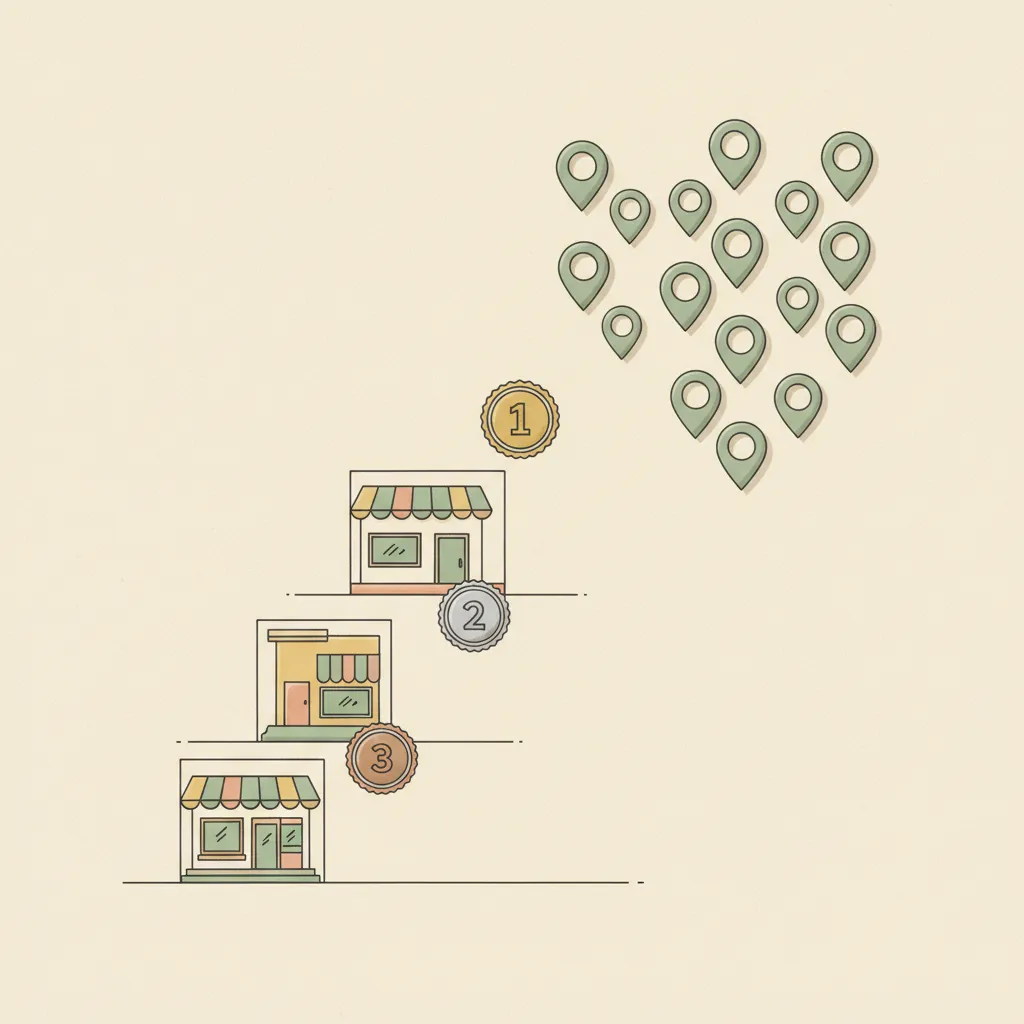
When someone searches "emergency plumber near me" or "dentist open Saturday," the first thing they see — above the organic blue links — is a map and three business listings. That box is the Google Local Pack, and it drives the majority of clicks for local service queries.
If your business isn't in those three spots, you're effectively invisible to most searchers. This guide explains what the Local Pack is, how Google decides who appears, and what you can do to earn one of those top positions.
What Is the Google Local Pack?
The Google Local Pack (also called the Map Pack or Local 3-Pack) is a block that appears on Google Search results pages when the query has local intent. It shows:
- A Google Maps snippet with pins
- Three business listings, each with: name, average star rating, review count, category, address, and hours
- A "More places" link that expands to a full local results page
The Local Pack appears above organic results for the vast majority of "near me" and "[service] in [city]" queries. For service businesses, it is consistently the highest-traffic placement on the page.
Why the Local Pack Is So Valuable
Consider what a user sees in the Local Pack before clicking anything:
- Your business name
- Your star rating and review count
- How far away you are
- Whether you're open right now
- A direct call button on mobile
A business with 4.7 stars and 200 reviews showing in position 1 captures dramatically more clicks than an organic result at the same position. The Local Pack condenses trust signals into a scannable card format that's optimized for the "I need this now" buyer.
How Google Selects the Top 3
Google's public documentation describes three ranking factors for local results: relevance, distance, and prominence. For the Local Pack specifically, here is how each factor plays out:
Relevance
Google matches your listing to the searcher's query based on:
- Your primary and secondary GBP categories — the most important single signal for relevance
- The services you've listed on your GBP
- Keywords in your business description, Google Posts, and Q&A
- Your website content, which Google crawls to supplement your GBP data
A dental practice that hasn't added "teeth whitening" or "Invisalign" as services is unlikely to appear for those specific queries, even if they offer both.
Distance
Google uses the searcher's physical location (or the location in the query) to favor nearby businesses. Distance is the factor you have the least control over — you can't move your office. What you can influence:
- For service-area businesses (plumbers, HVAC, landscapers, mobile detailers): set your service area accurately in GBP so Google understands your geographic reach
- Build local landing pages on your website for each city or neighborhood you serve — these help you rank in areas where you don't have a physical address
Prominence
Prominence is how well-known and trusted Google considers your business. This is the most actionable factor in the short term:
- Review count: more verified Google reviews is directly correlated with higher Local Pack rankings
- Average star rating: a higher rating increases click-through rate and contributes to prominence
- Review recency: a recent, consistent stream of reviews outperforms a large but dated review history
- Backlinks: links from other reputable websites signal authority
- Citations: consistent mentions of your business name, address, and phone across the web
- GBP engagement: clicks, calls, direction requests, and website visits from your listing
For a full breakdown of every ranking signal and how they're weighted, see local SEO ranking factors.
The Five Things That Move Local Pack Rankings Most
1. Max Out Your GBP Profile Completeness
An incomplete profile loses relevance matches it could otherwise win. Check every section:
| GBP Section | Common Mistake |
|---|---|
| Primary category | Too broad (e.g., "Contractor" instead of "HVAC Contractor") |
| Services | Left blank or only partially filled |
| Business description | Empty or no mention of primary service/city |
| Photos | Fewer than 10, or only stock images |
| Hours | Outdated or missing holiday hours |
| Website | Not linked, or links to a generic domain |
Complete every section. Use specific categories. List every service you offer.
2. Build a Consistent Review Velocity
A burst of 50 reviews in one month followed by nothing for six months performs worse than a steady cadence of 5–10 new reviews per month. Google's algorithm treats recency as a signal of an active, in-business operation.
The most effective way to build consistent review velocity is to ask every customer, every time, immediately after service. An automated SMS sent within minutes of job completion — before the customer has left your location or gotten home — consistently outperforms email, in-person asks, and follow-up calls.
Critical compliance note: the same review link must go to every customer. Showing a private feedback form to customers you expect to rate you poorly (and reserving the Google link for satisfied customers) is review gating — it violates Google's policies and can result in profile suspension.
3. Fix NAP Inconsistencies
NAP consistency — having the exact same business name, address, and phone number across Google, Yelp, your website, Facebook, and citation directories — is a foundational trust signal. Discrepancies (different phone numbers, address formatting differences, old business names) erode Google's confidence in your listing.
Audit your listings on at least: Google Business Profile, Yelp, Facebook, Apple Maps, Bing Places, and the top 3–4 industry-specific directories for your vertical.
4. Add Services, Posts, and Q&A to Increase Keyword Coverage
Every service you list on your GBP is a potential relevance match for a search query. A plumber with 12 listed services has more chances to appear in the Local Pack than a competitor with 3.
Google Posts serve a similar function — each post is indexed and adds keyword context. One post per week with a brief description of a project, seasonal tip, or promotion is a low-effort habit that compounds over time.
The Q&A section is often ignored. Seed it yourself with the 5–6 questions customers most commonly ask, then answer them. It adds keyword content and reduces friction for prospects.
5. Earn Local Backlinks and Citations
Citations from respected directories (Yelp, Angi, industry-specific sites) confirm your business exists and is established. Local backlinks — from the chamber of commerce, a local news site, a neighborhood blog, or a trade association — are stronger signals because they reflect real community presence.
Prioritize quality over quantity. Ten citations from well-indexed, relevant directories outperform fifty low-quality directory submissions.
What Gets You Excluded from the Local Pack
Even well-optimized businesses can be filtered out or penalized for:
- Keyword stuffing the business name: adding descriptive keywords to your GBP name (e.g., "Mike's Plumbing | Drain Cleaning | Water Heaters Denver") violates Google's guidelines and can trigger suspension
- Duplicate listings: two active listings for the same business location confuse the algorithm and can result in both being filtered
- Policy violations on reviews: generating, buying, or gating reviews
- Inaccurate address or service area: listing a virtual office you don't staff, or a service area so large it's implausible
- Suspended profile: common after a GBP suspension due to any of the above — requires a reverification process
How to Know If Your Optimizations Are Working
Checking your own rank from your own device is unreliable — Google personalizes results based on your location and browsing history. The only accurate way to measure Local Pack position is with a neutral, location-aware rank tracker.
A geo-grid tracker places measurement points across your city and records your rank at each point. This tells you not just whether you're in the Local Pack for one query at your address, but how far your visibility extends geographically.
Combined with consistent work on the five factors above, tracking your geo-grid position over time shows you exactly which actions moved the needle.
For the comprehensive step-by-step playbook, see how to rank higher on Google Maps.
Quick-Reference Checklist
- Primary GBP category is the most specific possible
- All services listed with descriptions
- Business description written (750 chars, mentions city and primary service)
- Minimum 10 photos uploaded
- Hours accurate and complete
- Website linked and locally optimized
- Review request process automated for every completed job
- NAP identical across all major directories
- At least one Google Post published this week
- Q&A seeded with 5–6 common questions
GBP Autopilot handles the two most impactful items on this list automatically — TCPA-compliant SMS review requests after every job, and a geo-grid rank tracker so you can see your Local Pack position across your entire service area. Starting at $29/month.
Sources
- Google Business Profile Help. Tips to improve your local ranking on Google. https://support.google.com/business/answer/7091
- BrightLocal. Local Consumer Review Survey 2026. https://www.brightlocal.com/research/local-consumer-review-survey/
- BrightLocal. Understanding Google's Local Search Algorithm and Local Ranking Factors. https://www.brightlocal.com/learn/google-local-algorithm-and-ranking-factors/
- Whitespark. Local Search Ranking Factors 2025. https://whitespark.ca/local-search-ranking-factors/