 GBP Autopilot
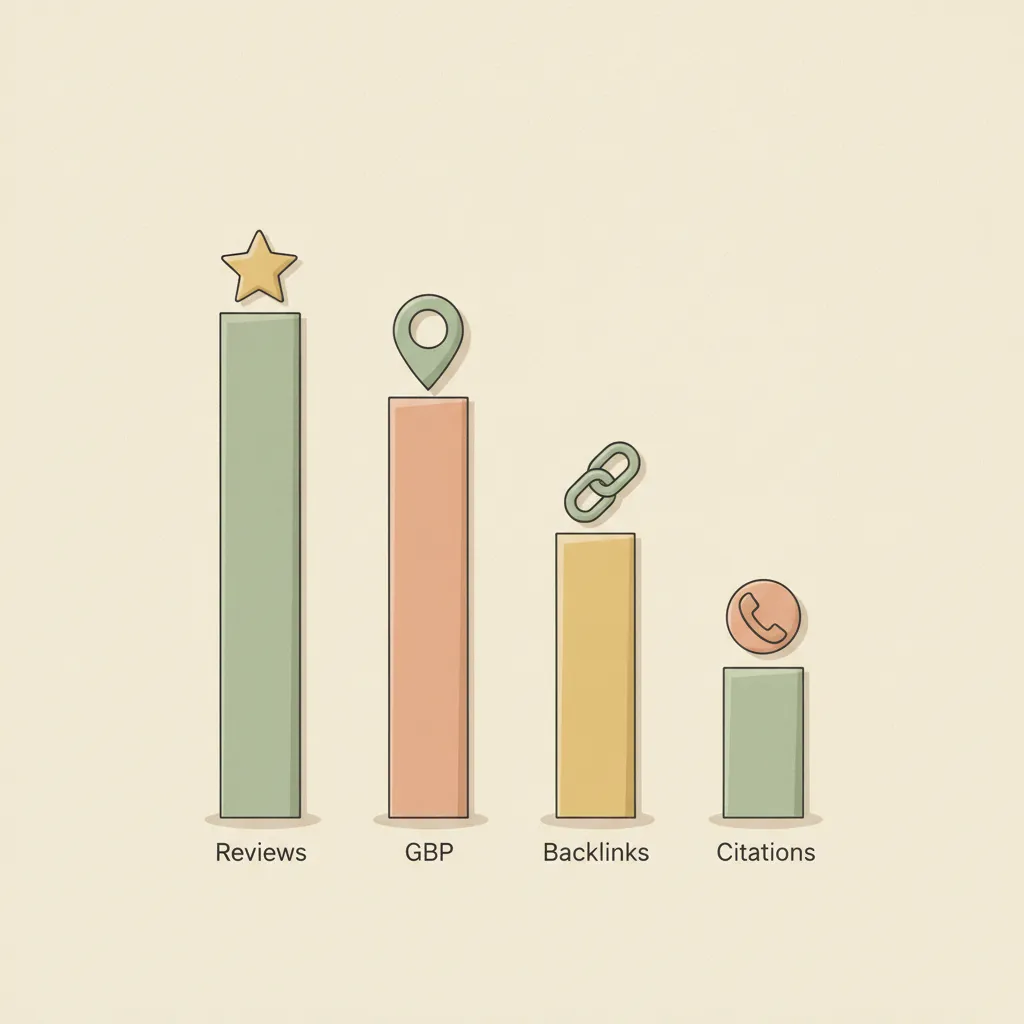
Understanding local SEO ranking factors is the foundation of any Google Maps strategy. You can spend time on dozens of tactics, but if you don't know which signals carry the most weight, you'll optimize the wrong things and leave your highest-leverage improvements untouched.
This guide covers the major categories of local ranking signals, what the current evidence says about their relative importance, and where to focus if you're running a local service business in 2026.
Google's Public Framework: Relevance, Distance, Prominence
Google's official guidance describes three factors that determine how local results are ranked. Every signal you can influence fits into one of these three buckets.
Relevance — How well your listing matches the searcher's query. This is driven by your GBP category, services, description, posts, and your website content.
Distance — How far your business is from the searcher or the location specified in the query. The least controllable factor for most businesses.
Prominence — How well-known and trusted Google considers your business. The most action-rich category: reviews, backlinks, citations, and engagement all live here.
The research from local SEO practitioners consistently confirms this framework while adding granularity about which specific signals matter most within each category.
GBP (Google Business Profile) Signals
GBP signals are the highest-impact factor category for local pack rankings — ahead of on-page SEO, link signals, and citation volume.
Primary Category
Your primary GBP category is the single most important relevance signal. It tells Google the fundamental nature of your business and determines which queries you're eligible to rank for.
Best practice:
- Choose the most specific category that accurately describes your core offering (e.g., "HVAC Contractor" rather than "General Contractor")
- Don't use a broader category just because it has higher search volume — specificity improves match quality
- Add secondary categories for additional services you offer
Service Completeness
Listing every service you offer — with descriptions — significantly expands your keyword footprint. Each service is a potential match for a relevant search query. A plumbing company with "water heater installation," "sewer line repair," "garbage disposal installation," and "gas line plumbing" listed has four times the relevance surface area compared to one with just "plumbing."
GBP Attributes and Features
Completing GBP attributes (accessibility features, payment methods, service options, health & safety) adds relevance and improves appearance in filtered searches. Businesses that fully use GBP features (posts, Q&A, photos, services, menus where applicable) consistently outperform those that treat it as a static listing.
Photo Activity
Regularly adding photos signals an active, current listing. Google favors listings that show ongoing engagement over dormant ones, even if the dormant listing was very complete at setup.
Review Signals
Review signals are the strongest prominence factor in the local algorithm and one of the most actionable for businesses.
Review Count
More verified Google reviews correlate strongly with higher local pack rankings. The relationship isn't perfectly linear — a business with 500 reviews doesn't necessarily outrank one with 150 in all cases — but the broad trend is consistent: businesses with more reviews tend to rank higher.
For most service businesses, the goal is to consistently generate new reviews, not to achieve a specific number. Velocity matters.
Average Star Rating
A higher average rating improves both rankings and click-through rate. The practical threshold for competitive markets is above 4.0 stars; businesses below that often get filtered out of the top 3 regardless of other signals.
Review Recency
A fresh stream of reviews outperforms a large but stale review count. If your last 10 reviews are from 18 months ago, that signals a dormant or declining business to the algorithm. A steady cadence of new reviews — even 3–5 per month — is more valuable than 50 reviews followed by nothing.
Review Responses
Responding to reviews (both positive and negative) is a positive signal. It demonstrates active management of the listing and contributes to engagement metrics. Responding to negative reviews professionally also has a demonstrated effect on conversion: prospective customers who see a thoughtful response to a complaint are more likely to give the business a chance.
For a full treatment of why reviews matter for rankings, see why Google reviews matter for local SEO.
On-Page / Website Signals
Your website feeds the local algorithm even though rankings happen through your GBP. Google uses your website to validate and supplement what your GBP claims.
NAP Consistency
Your business name, address, and phone number must match exactly between your GBP, your website's contact page, your website footer, and every citation across the web. Discrepancies erode trust signals. This is covered in depth in the NAP consistency guide.
Local Keyword Optimization
Title tags, H1s, and body content that mention your services and city/region help Google associate your website with specific local queries. Format: "[Service] in [City] | [Business Name]".
Location Pages
For multi-location businesses or service-area businesses that cover multiple cities, dedicated location pages with unique, locally relevant content signal coverage to Google. These pages should have distinct content — not duplicated templates with just the city name swapped.
Page Speed and Core Web Vitals
A slow website hurts both organic rankings and the website visit signal that feeds your GBP prominence score. Google's Core Web Vitals (LCP, CLS, FID/INP) are confirmed ranking factors.
Link Signals
Backlinks to your website from other reputable sites contribute to prominence. For local businesses, the most valuable links come from:
- Local sources: chamber of commerce, local newspaper, neighborhood association, local event sponsors
- Industry sources: trade associations, supplier websites, professional directories
- Review sites: Yelp, Angi, and similar platforms typically include a website link — these carry citation value as well as some link equity
Quantity matters less than quality and relevance. A single link from a local newspaper is worth more than 50 links from low-quality directories.
Citation Signals
Citations — mentions of your business name, address, and phone on external sites — contribute to prominence and help Google validate that your business exists at your claimed location.
Citation volume: more citations from diverse, authoritative sources is better than fewer, up to a point. The marginal value of citation #200 is much less than citation #10.
Citation consistency: inconsistent citations (different phone numbers, address formats, or business names) create conflicting signals and can suppress rankings.
Citation authority: a citation on Yelp or a major industry directory carries more weight than a citation on a low-traffic generic directory no one reads.
For the full citation-building framework, see the local citations guide.
Behavioral Signals
Behavioral signals — what users do after seeing your listing — are an increasingly discussed factor in local rankings. These include:
- Click-through rate: how often users click your listing relative to how often it's shown
- Direction requests: users asking Google Maps for directions to your location
- Calls from GBP: phone calls initiated directly from your listing
- Website visits from GBP: clicks to your website from your listing
- Check-ins: physically verified visits to your location (primarily relevant for retail/restaurants)
Higher engagement with your listing sends a signal that users find it relevant and credible. This creates a compounding effect: businesses that appear in the top 3 get more clicks, which generates more engagement signals, which can further reinforce their ranking.
You can't directly manufacture behavioral signals, but you can influence them through strong reviews, accurate hours, compelling photos, and complete information that makes your listing worth clicking.
Personalization Signals
Local results vary by user. Google personalizes based on:
- Search history: previous searches and location behavior
- Physical location: where the user is at the moment of search
- Device: mobile vs. desktop results can differ
- Prior engagement: businesses you've interacted with may surface differently for you than for others
This is why searching for your own business ranking from your office is unreliable. You need a third-party rank tracker that measures from neutral, customer-representative locations.
Priority Matrix for Service Businesses
Given the above, here's how to prioritize if you're starting from scratch or doing a major optimization:
| Priority | Signal Category | Key Action |
|---|---|---|
| 1 | GBP completeness | Fill every section; choose specific primary category |
| 2 | Review velocity | Automate ask after every job; respond to every review |
| 3 | Website NAP | Match GBP exactly on contact page and footer |
| 4 | Service listings | Add all services with descriptions |
| 5 | Core citations | Build presence on 10–15 authoritative directories |
| 6 | GBP Posts | Publish at least weekly |
| 7 | Location pages | One per city/area you serve |
| 8 | Local backlinks | Chamber, associations, local press |
| 9 | Behavioral | Improve photo quality; keep hours accurate |
What Changed in 2025–2026
The Whitespark 2025 Local Search Ranking Factors survey (the definitive annual expert survey) flagged several notable trends:
- AI-powered local results (Google's AI Overviews) are beginning to surface local businesses for informational queries — GBP completeness and review quality influence AI Overview inclusion
- Review signals continue to gain weight relative to citation signals, reflecting Google's emphasis on trust and recency
- Behavioral signals are increasingly discussed by practitioners as meaningful, especially for competitive markets
For the comprehensive action plan across all these signals, see how to rank higher on Google Maps.
GBP Autopilot automates the two highest-weight signal categories for local businesses: consistent review generation via TCPA-compliant SMS and geo-grid rank tracking to measure where your optimizations are working. Plans start at $29/month.
Sources
- Google Business Profile Help. Tips to improve your local ranking on Google. https://support.google.com/business/answer/7091
- BrightLocal. Understanding Google's Local Search Algorithm and Local Ranking Factors. https://www.brightlocal.com/learn/google-local-algorithm-and-ranking-factors/
- Whitespark. Local Search Ranking Factors 2025. https://whitespark.ca/local-search-ranking-factors/
- BrightLocal. Local Consumer Review Survey 2026. https://www.brightlocal.com/research/local-consumer-review-survey/