 GBP Autopilot
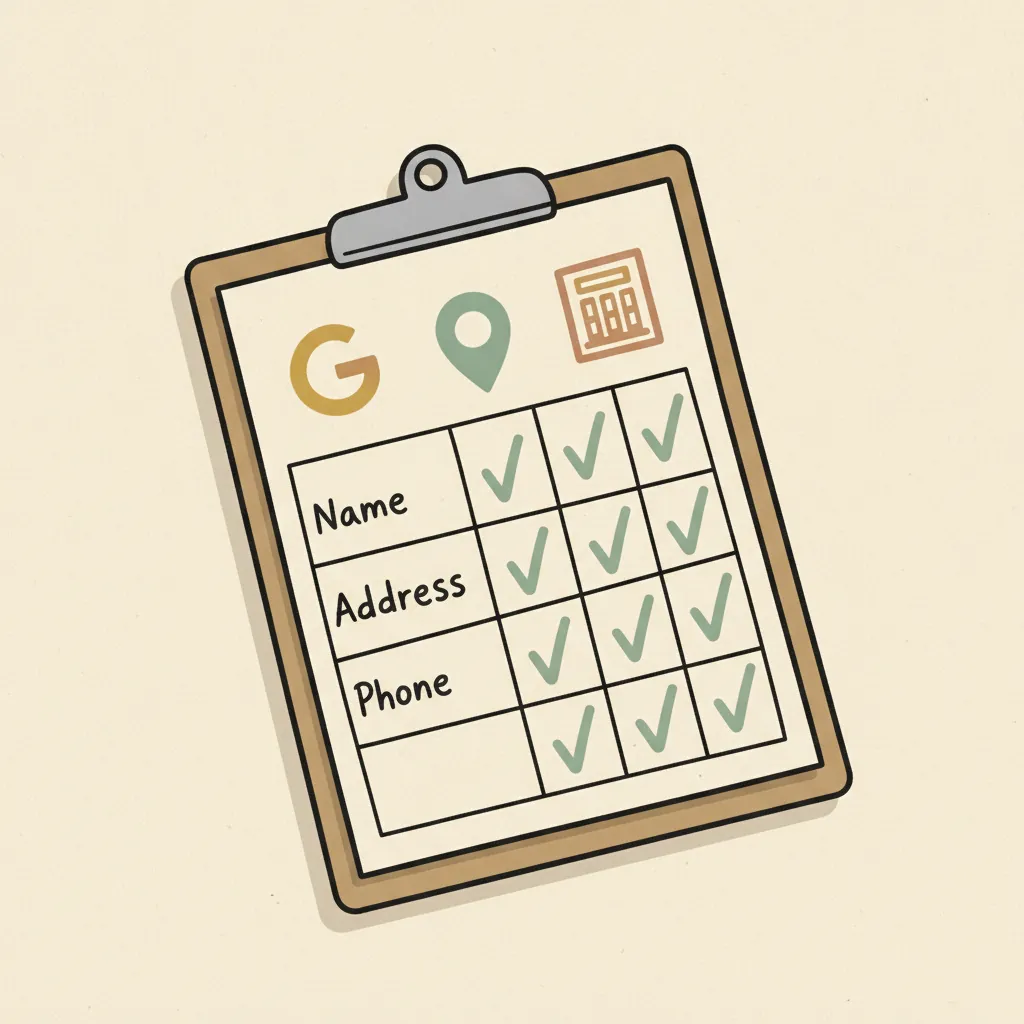
If your plumbing business is listed as "Gary's Plumbing LLC" on Google, "Gary's Plumbing" on Yelp, and "Gary Plumbing Services" on your website, Google sees three different businesses — not one authoritative one. That confusion is NAP inconsistency, and it's one of the most common and underdiagnosed problems in local SEO.
NAP stands for Name, Address, and Phone number — the three pieces of identifying information that anchor your business identity across the web. When these are consistent everywhere your business is mentioned, Google's confidence in your listing increases. When they're inconsistent, it signals uncertainty about your business's legitimacy and location — which can suppress your rankings in the Google Local Pack.
Why NAP Consistency Is a Trust Signal
Google's local algorithm works, in part, by cross-referencing information from hundreds of sources: your Google Business Profile, your website, Yelp, Facebook, Apple Maps, industry directories, local news mentions, data aggregators, and more. When all of those sources agree on your business name, address, and phone, it reinforces Google's confidence that your GBP represents a real, established business at the claimed location.
When the sources conflict — different phone numbers, different business name formats, old addresses that haven't been updated after a move — Google has less confidence. The result is typically lower local rankings, not a full disappearance from Maps (that's usually a verification or suspension issue). But in competitive markets, even a modest ranking suppression from inconsistent citations can mean the difference between position 2 and position 8.
The practical impact is highest for newer businesses and those in competitive verticals. An established business with hundreds of citations and strong review signals can tolerate some inconsistency. A business with 20 citations where 10 are inconsistent has a bigger proportional problem.
The Three Dimensions of NAP Consistency
Name
Your business name should be exactly as it's registered and how you'd like it presented publicly. That means:
- Use the same legal or trade name everywhere — not abbreviations on some sites and full names on others
- Don't include keyword descriptors ("Best HVAC in Phoenix") in your business name on any directory — this violates Google's guidelines and looks inconsistent on other sites where you use your real name
- If your business has changed its name, audit every citation and update them
Common inconsistencies:
- "LLC" or "Inc." included on some listings, omitted on others
- Ampersand vs. "and" (e.g., "Smith & Sons" vs. "Smith and Sons")
- Abbreviations (e.g., "Plbg." vs. "Plumbing")
Address
Address formatting is the trickiest NAP element because there are many ways to write the same address:
- "Street" vs. "St" vs. "St."
- "Suite 101" vs. "#101" vs. "Ste. 101"
- "North Main Street" vs. "N. Main St"
- Zip+4 vs. 5-digit zip
Choose a canonical format for your address and use it everywhere. The USPS standardized format is a good default: spelled-out street type (Street, Avenue, Boulevard), numerical suite designations.
Special case — service-area businesses: if you've hidden your address on GBP (common for home-based service businesses), don't list your home address on other directories. Either omit the address or set a consistent P.O. Box or registered agent address that you use everywhere.
Special case — moved businesses: if you've relocated, old addresses on directories are actively harmful. They conflict with your current GBP address and can cause Google to question which location is correct.
Phone Number
Use a local phone number wherever possible. Toll-free numbers are fine as a secondary contact, but a local area code number signals geographic presence to both Google and searchers.
Use the same format consistently:
- (602) 555-1234 or 602-555-1234 or 602.555.1234 — pick one and use it everywhere
- Don't mix formats across listings
Avoid call-tracking numbers in citations: some businesses use different tracking numbers on different platforms to measure call source. This creates NAP inconsistencies. If you need call tracking, use it on your website and GBP but maintain a consistent static number for citation directories, or use a tool that allows number forwarding while maintaining consistent public display.
How to Audit Your NAP Consistency
Step 1: Establish Your Canonical NAP
Before you can fix inconsistencies, you need to decide on the definitive version of your business name, address, and phone. Write it down and treat it as your reference standard:
Business Name: [Exact name as you want it everywhere]
Address: [USPS-formatted street address, city, state, zip]
Phone: [(xxx) xxx-xxxx format]
This is your source of truth. Everything else gets updated to match this.
Step 2: Audit the High-Priority Directories
Start with the platforms that carry the most weight with Google and have the most citation authority:
| Platform | Priority | Notes |
|---|---|---|
| Google Business Profile | Critical | The anchor — everything else should match this |
| Your own website (footer, contact page) | Critical | Schema markup on contact page helps |
| Yelp | High | Major citation authority, often scraped by others |
| Facebook Business | High | Google cross-references social profiles |
| Apple Maps | High | Significant for iPhone users |
| Bing Places | High | Separate from Google; worth maintaining |
| BBB (Better Business Bureau) | Medium | Trusted source for Google |
| Chamber of Commerce | Medium | Local authority signal |
| Angi / HomeAdvisor | High (home services) | Industry-specific directories |
| Healthgrades / Zocdoc | High (healthcare) | Industry-specific directories |
| Avvo / FindLaw | High (legal) | Industry-specific directories |
| RepairPal | High (auto repair) | Industry-specific directories |
Step 3: Search for Citations You Don't Know About
Beyond the obvious platforms, your business may be listed on data aggregators (Foursquare, Neustar/Localeze, Infogroup, Acxiom) and dozens of smaller directories that picked up your information from public records or other sources. These citations exist whether you know about them or not — and they can be inconsistent.
Search strategies to find unknown citations:
- Google:
"[business name]" "[city]"— check the first 5–10 pages - Google:
"[old phone number]"— surfaces listings with your old number - Google:
"[old address]"— surfaces listings with your previous address - BrightLocal, Moz Local, or Yext's citation audit tools (paid, but thorough)
Step 4: Correct or Remove Inconsistent Listings
For each inconsistency you find:
- If you can edit the listing (you have an account): update to your canonical NAP
- If you can claim it (unclaimed listing): claim it and update
- If you can't edit or claim it (auto-generated, old directory): contact the site's support to request a correction, or use a data aggregator service to suppress the wrong information at the source
Note: it can take 4–8 weeks for corrections to propagate across aggregators and get re-crawled by Google. Don't expect instant ranking improvement — NAP fixes are a long-game signal.
Maintaining Consistency Going Forward
Once you've done the initial audit and cleanup, consistency maintenance is mostly preventative:
- Use your canonical NAP document every time you create a new listing
- When you change your phone number or move, run a full audit immediately — don't let the old information age
- If you change your business name (rebranding, merger), update all citations before changing your GBP name — search for the old name to find stragglers
- Review your website footer and contact page annually
The Relationship Between NAP and Citations
NAP consistency and citation building are closely related but not the same thing. Citations are the listings themselves — the presence of your business information on external sites. NAP consistency is about the accuracy of that information across those citations.
Both matter. More authoritative citations with consistent NAP is the goal. Lots of citations with inconsistent NAP, or no citations at all despite perfect GBP setup, both leave points on the table.
For how to build new citations strategically, see the local citations guide.
For the complete picture of how citation signals fit alongside reviews, links, and GBP completeness, see local SEO ranking factors for 2026.
A Note on Schema Markup
For an additional layer of NAP consistency signal, add LocalBusiness schema markup to your website's contact page or footer. Schema markup gives Google structured data that confirms your NAP in machine-readable format. It's a small technical addition with a measurable local SEO benefit.
Minimum useful implementation:
{
  "@context": "https://schema.org",
  "@type": "LocalBusiness",
  "name": "Your Business Name",
  "address": {
    "@type": "PostalAddress",
    "streetAddress": "123 Main St",
    "addressLocality": "Phoenix",
    "addressRegion": "AZ",
    "postalCode": "85001"
  },
  "telephone": "(602) 555-1234"
}
Quick-Reference Checklist
- Canonical NAP document created and saved
- GBP listing matches canonical NAP exactly
- Website footer and contact page match canonical NAP
- Yelp, Facebook, Apple Maps, Bing Places audited and corrected
- Industry-specific directories audited (Angi, Healthgrades, Avvo, etc.)
- Google search for old phone numbers and old addresses completed
- Unknown citations found and corrected or removed
- LocalBusiness schema added to website
- Process documented for future changes (move, rebrand, new number)
GBP Autopilot includes competitor intel that shows you where competing businesses are listed and what their NAP looks like — useful for understanding the citation landscape in your market. Combined with geo-grid rank tracking, you can see whether your NAP cleanup is translating to improved visibility across your service area. Plans start at $29/month.
Sources
- Google Business Profile Help. Guidelines for representing your business on Google. https://support.google.com/business/answer/3038177
- BrightLocal. Understanding Google's Local Search Algorithm and Local Ranking Factors. https://www.brightlocal.com/learn/google-local-algorithm-and-ranking-factors/
- Whitespark. Local Search Ranking Factors 2025. https://whitespark.ca/local-search-ranking-factors/
- Google Business Profile Help. Verify your business on Google. https://support.google.com/business/answer/7107242