 GBP Autopilot
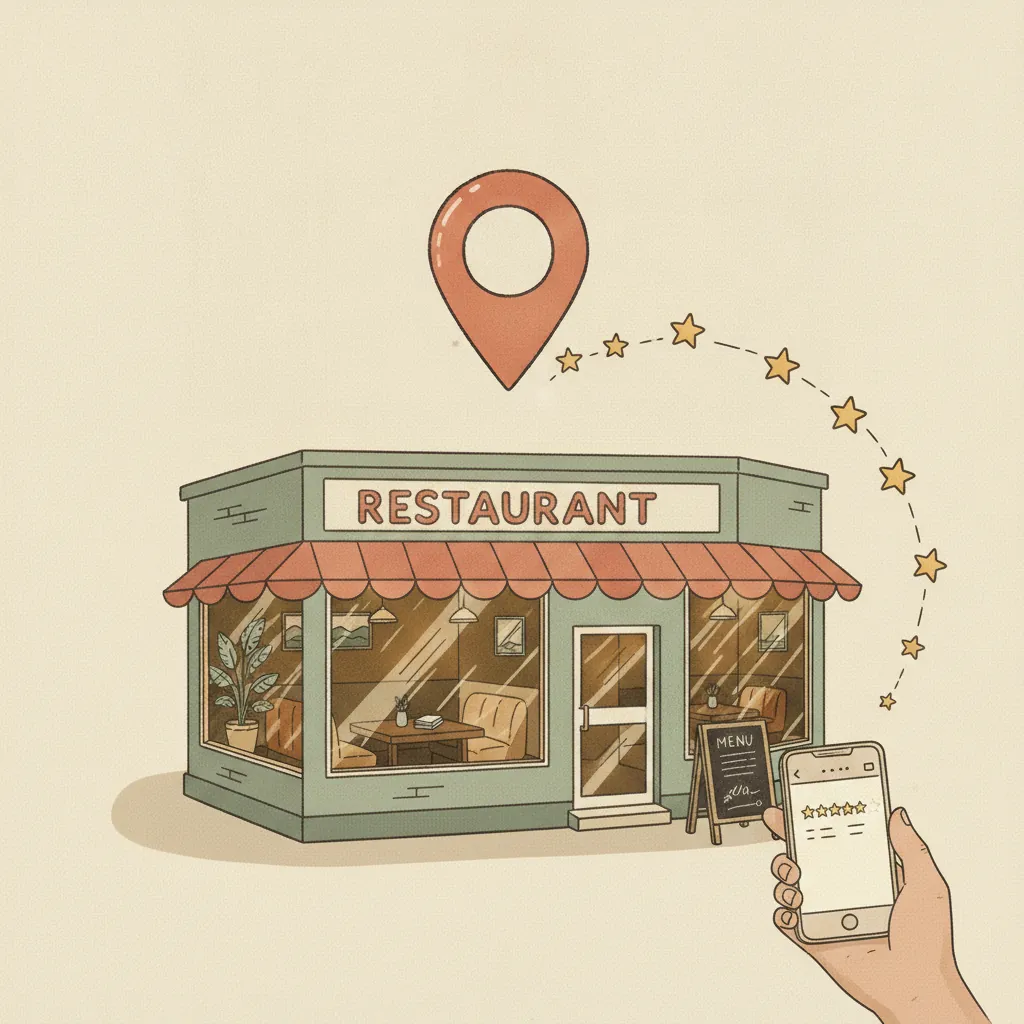
Restaurant reviews are the closest thing the dining industry has to word-of-mouth at scale. When someone is standing on a sidewalk at 6:30 p.m. deciding where to eat, the first thing they do is pull up Google Maps. The three restaurants in the local pack — the ones with hundreds of reviews and a 4.5-star average — take almost all the walk-in traffic. The ones buried below the fold get the scraps.
Getting more restaurant reviews on Google isn't about gaming the system. It's about removing the friction that stops happy customers from telling the world what they already told your server: that dinner was great.
Why Google Reviews Matter More for Restaurants Than Any Other Vertical
Restaurants face uniquely intense review pressure. Diners decide fast, decide emotionally, and decide based almost entirely on what strangers say. According to BrightLocal's Local Consumer Review Survey 2024, nearly one-quarter of consumers (24%) expect a review request on the same day as their restaurant visit — a much tighter window than most other business categories. Another 48% want to be asked within two to three days.
The implication: if you wait a week to follow up, the emotional peak of a great meal has passed, and so has your best shot at a review.
Google reviews also directly influence your Maps ranking through review signals — including review count, recency, and keyword content. A restaurant with 400 reviews mentioning "best tacos in Austin" ranks for that phrase in the local pack. One with 40 reviews, even older ones, doesn't.
Beyond rank, social proof converts browsers into bookings. 71% of consumers won't consider a business averaging below three stars (BrightLocal, 2024). For fine dining, the bar is higher — many consumers filter for 4.0+ before they even look at the menu.
For the full picture of how reviews interact with your Google Maps ranking, see local SEO for restaurants.
The Right Way to Ask: Timing, Channel, and Wording
Timing: Strike While the Emotion Is Hot
The best moment to ask for a review is immediately after a peak experience — when the dessert plate is cleared, when a customer compliments the food unprompted, when someone mentions they'll definitely be back. That's the window.
In practice, two channels work best for restaurants:
1. In-person ask at the table. Train your servers to say something natural when dropping the check or boxing up leftovers. This doesn't have to be a script — "If you enjoyed dinner, we'd really appreciate a quick Google review; it means a lot to a small place like ours" lands better than something that sounds rehearsed.
2. Post-visit SMS. A single text sent within a few hours of the visit — not days later — captures diners while the experience is still vivid. This is where automation earns its keep: you can't manually text every table, but software can.
For a deeper look at the mechanics of a well-written ask, see how to ask for reviews.
TCPA Compliance for Restaurant SMS Review Requests
If you use SMS to follow up with diners, federal TCPA law requires explicit written opt-in before you send marketing texts. For restaurants, this means:
- Collect opt-in at the point of capture — reservation form, loyalty sign-up, or Wi-Fi login. The checkbox must be explicit: "I agree to receive SMS messages from [Restaurant Name]."
- Include STOP/HELP instructions in every message.
- Honor quiet hours — no texts before 9 a.m. or after 9 p.m. in the recipient's local time zone.
- Never gate — send the review link to every customer who opted in, not just the ones who seemed happy. Review gating (filtering by predicted sentiment before sending the link) violates Google's review policies and the FTC's 2024 rule on consumer reviews.
See how to get more Google reviews for a compliant review-request framework that applies across any local business.
Wording That Works
Short, warm, and specific beats long and generic. Here are three tested templates for restaurant SMS follow-ups:
Template A — casual dining:
"Hey [First Name], thanks for dining with us tonight! If you enjoyed your meal, a quick Google review helps us more than you know: [review link]. Reply STOP to opt out."
Template B — after a special occasion:
"Hi [First Name] — hope your celebration dinner was everything you wanted! We'd love a Google review if you have 2 minutes: [review link]. Reply STOP anytime."
Template C — for loyalty program members:
"[First Name], glad to see you again last night! Your feedback on Google means a lot to our team: [review link]. Reply STOP to unsubscribe."
Notice what's absent from all three: any mention of discounts, freebies, or conditions. The FTC's Trade Regulation Rule on Consumer Reviews (16 CFR Part 465, effective October 21, 2024) prohibits conditioning a review request on a particular outcome or sentiment. Offering a free dessert "for a 5-star review" is a federal violation carrying civil penalties of up to $51,744 per incident — not a strategy worth testing.
The Review Funnel: From Table to Google in 5 Steps
Most restaurant owners think the hard part is getting customers to agree to leave a review. The actual hard part is removing the friction between "I'll do it" and "I did it." Here's a practical funnel:
- Capture opt-in at reservation or loyalty sign-up. Make the SMS checkbox visible and plain-language — not buried in terms.
- Send one SMS within 2–4 hours of the visit. Include a direct link to your Google review form (not your website homepage — the actual review URL).
- Make the link one tap. A direct Google review deep link opens the review form immediately on mobile. No hunting, no extra clicks.
- Respond to every review within 48 hours. BrightLocal's 2026 survey found 89% of consumers expect business responses, and 80% are more likely to choose a business that responds to all reviews. Responding to positive reviews also signals to future readers that the experience will be acknowledged.
- Never respond to negative reviews with patient or customer details. For restaurants without healthcare complications, this is about basic professionalism — don't argue publicly, don't reveal a customer's order or table details without their explicit consent.
Restaurant-Specific Review Checklist
Use this before you launch any review-generation campaign:
| Step | Action | Compliant? |
|---|---|---|
| Opt-in collection | SMS checkbox at reservation / loyalty sign-up | Required |
| Timing | SMS sent same day or within 24 hours | Best practice |
| Universal ask | All opted-in customers get the link, not a filtered subset | Required |
| No incentives | No discount, freebie, or reward offered for leaving a review | Required |
| STOP/HELP in every SMS | Present in message body | Required |
| Quiet hours enforced | No texts before 9 a.m. or after 9 p.m. local time | Required |
| Direct review URL | Links to Google review form, not your website | Best practice |
| Response cadence | Every review gets a response within 48–72 hours | Best practice |
| Keyword-rich responses | Mention dish names, neighborhood, occasion in responses | Best practice |
| Review page photos | Profile has 10+ high-quality food/interior photos | Best practice |
What to Do With Your Reviews Once You Have Them
Getting reviews is step one. Making them work harder is step two.
Respond with keywords. When a customer praises your wood-fired pizza, respond with something like: "So glad the wood-fired pizza hit the mark — that's a dish our team is really proud of. We'd love to see you again soon at [Restaurant Name] in [Neighborhood]." Google indexes review responses. Mentioning your dishes, neighborhood, and occasion type in responses adds semantic richness to your Maps listing.
Use reviews in your GBP posts. Google Business Profile allows you to publish weekly posts. A screenshot of a glowing review (with permission, or the public text) repurposed as a post reinforces social proof and keeps your profile active — both ranking signals.
Track your review velocity. A sudden spike in reviews followed by a plateau is less valuable, ranking-wise, than a steady drip of 3–5 new reviews per week. Consistent velocity signals an active business. Automation handles this: a restaurant seeing 50 covers per night shouldn't be manually texting 350 diners per week.
GBP Autopilot's SMS review request tool handles the entire funnel — opt-in capture, timed sends, quiet-hour enforcement, and direct review links — for $29/month. You get the review velocity without the manual work. Try it free for 14 days →
Sources
- BrightLocal. Local Consumer Review Survey 2024. BrightLocal, 2024.
- BrightLocal. Local Consumer Review Survey 2026. BrightLocal, 2026.
- Federal Trade Commission. 16 CFR Part 465: Trade Regulation Rule on the Use of Consumer Reviews and Testimonials. Effective October 21, 2024.
- Google. Tips to get more reviews. Google Business Profile Help.
- Google. All Business Profile policies & guidelines. Google Business Profile Help.